
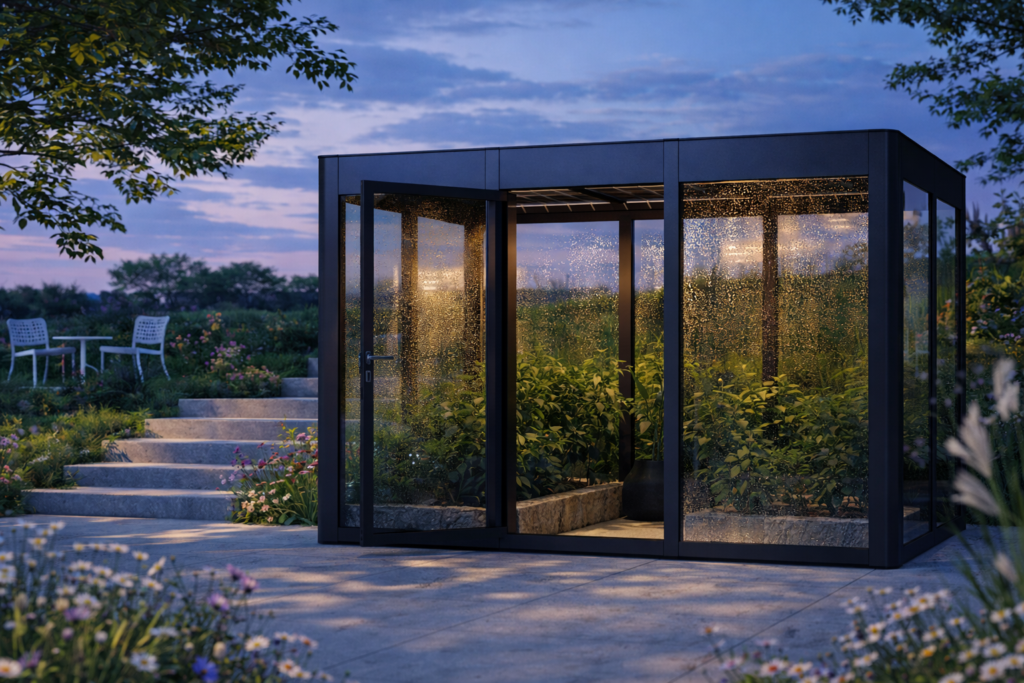
Combined outdoor solutions with photovoltaics as standard
A greenhouse is not an “outside with glass” – it is a climate system in its own right. If you only “heat it somehow” in winter or “ventilate it now and then” in summer, you will reliably get the classics: condensation, mold, weak plants, stress due to temperature jumps.
The clean solution is a triad of sensor technology, airflow and heating strategy – supported by automation (window opener) and shading. That’s what it’s all about here: practical, easy to understand, immediately implementable – including accessories that you can retrofit directly with SunElements.
1) Sensors: Without measured values, it's all just a gut feeling
If you only optimize one thing: measure instead of guessing.
You don’t need high-end IT – a solid thermo/hygrometer (or 2 sensors in different places) is enough.
Target values as orientation
- Humidity: roughly 60-80 % as a sensible range for many greenhouse situations (above this, mold/fungus pressure increases significantly).
- Temperature: strongly plant-dependent – but the rule remains: stability beats peak values.
Everyday tip
- Don’t just measure in the middle: a sensor at plant height and one near the roof/upper zone will show you whether you have heat build-up or cold spots.
- Check in the morning: If windows are dripping → you have too much moisture + too little air exchange at night.
Accessory lever from SunElements (for clean retrofitting)
Interior cladding helps to route cables and hoses neatly and avoid moisture chaos.
2) Ventilate properly: Moisture out without shocking the plants
Airing is not a ritual, but moisture management. Your main enemy is not the cold – it’s condensation, which triggers fungi and rot.
The rule of thumb
- Rather short & efficient (air exchange) than “a gap” for hours (cools down, brings little air exchange).
When to ventilate?
- In the morning, when it is drier outside and the temperature rises.
- In winter, only ventilate briefly during frost-free periods – but do so consistently.
What are the real benefits of automation?
- Automatic window openers often work with a wax/gas cylinder that expands when heated and opens the window – it closes again when it cools down. This is simple, robust and currentless.
SunElements accessories that pay directly here
- Window for targeted ventilation/cross ventilation (instead of door improvisation). Link to window accessories
- The integrated ventilation flap on the roof provides additional air circulation and helps excess moisture to escape more quickly.
3) Humidity under control: the 5-minute checklist
If your humidity is regularly too high, do this sequence:
- Switch to watering in the morning instead of the evening (moisture can get out during the day).
- Cover the soil: Mulch/mats reduce evaporation peaks.
- Thin out the plants: Air must pass through the leaves.
- Ventilate + move air: if necessary, use a small air circulation fan (prevents standing moisture pockets).
- Combine heating impulse + ventilation impulse: warm up briefly → air can hold more water → then ventilate (moisture really out).
4) Frost guard: Not "warm", but "frost-proof" - that saves money
A frost monitor is not a living room radiator. Its job is to maintain a minimum temperature, automated via a thermostat.
Practical setup
- Frost monitor with thermostat switches on when the temperature falls below the setpoint.
- Typical frost protection setpoints are often 5-10 °C (depending on the plant population).
Most important strategy: Zone heating
- Do not heat the whole room, but the plant zone + critical corner (cold falls, corners cool down).
- Add thermal mass (water canister/stones): buffers temperature fluctuations overnight.
Mistake that costs you a harvest
- “Continuous heating on the off chance” → dries out at certain points, still produces condensation on cold surfaces and eats up electricity.
5) Automatic window opener + intelligent shading
Summer operation without heat collapse
In summer, a greenhouse quickly turns into a sauna. Ventilation alone is often not enough – you need to reduce the heat input and actively remove the warm air.
The SunElements advantage:
With SunElements, shading is sometimes included “free of charge”:
- The photovoltaic roof reduces the direct solar input without you having to install additional nets.
- At the same time, acrylic glass ensures that UV components (UVA/UVB) are filtered much more effectively than with many conventional glazing systems – plants and material are therefore better protected against UV stress.
Nevertheless:
Even if UV is reduced, a greenhouse can overheat – the biggest driver is heat input (solar energy) plus heat build-up. That is why the combination remains crucial:
- Automatic window openers for constant air exchange
- PV as basic shading
- optional additional shading (e.g. ceiling or wall pleated blinds as internal sun and privacy protection) if your location is extremely sunny or you have sensitive crops
Quick tip: If you regularly feel “stagnant” warm air inside or have condensation in the morning: automatic ventilation + cross ventilation is mandatory – shading is the booster, not the replacement.
6) Bonus: Keep winter plants "stable" - light is part of the heating strategy
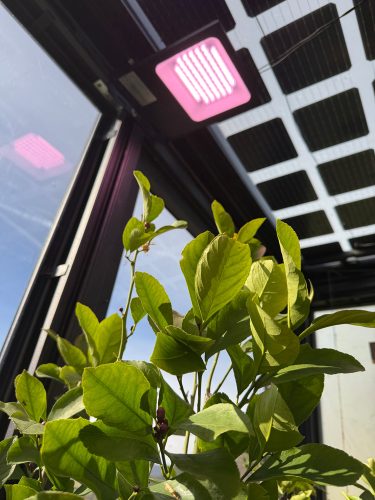
Many winter problems are actually light problems: Plants are too warm with too little light → become soft, susceptible, go to seed.
Business clear tip
- If you keep frost-free in winter, include light – otherwise you will be wasting growth potential.
SunElements accessories
Plant lamp LED (ideal for growing & winter quarters for plants).
7) Quick wins: 10 everyday tips that work immediately
- 2 sensors (top/bottom) instead of one number.
- Ventilate briefly and vigorously, not in “split mode”.
- Water in the morning, not in the evening.
- Do not press sheets against panes (condensation zone).
- Set the frost monitor to minimum protection (plant-dependent), not to “cozy”.
- Pure thermal mass: Water canister as a heat buffer.
- In case of high humidity: heat → ventilate (in this order).
- Automatic window openers: check the mechanism regularly (smooth-running, correctly adjusted).
- Summer: Install shading before the hot day, not after.
- Tidiness with cables/hoses reduces missing parts & moisture problems (interior cladding).
FAQ: Frost monitor, ventilation & heating in the greenhouse
What is the minimum temperature a greenhouse should be in winter?
That depends on your plants. For “frost-free overwintering”, many aim for 5-10 °C as a minimum range – the decisive factor is that the temperature does not fall below your plant limit at night.
Is a frost monitor alone sufficient against high humidity?
No. A frost guard increases the air temperature, but humidity only disappears through air exchange. The combination is effective: warm up briefly → then ventilate the room so that the moist air really goes out.
When should I ventilate in winter without cooling everything down?
It is best to ventilate briefly and specifically during milder, dry periods of the day (often in the morning). Keeping the windows permanently “on tilt” brings little air exchange, but cools things down unnecessarily.
How does an automatic window opener work? Does it need electricity?
Many models work without electricity via a wax/thermal cylinder: when warm, it expands and opens; when cold, it contracts and closes again.
What humidity level is “okay” in the greenhouse?
A rough guide is often 60-80 %. If you regularly go well above this (and have condensation on the panes), the risk of fungal diseases increases – you then need to optimize ventilation, watering times and air movement.
Which is better: heating at night or heating in the morning?
If there is a risk of frost, you must ensure a minimum temperature at night. A short heating impulse in the morning is practical against moisture, because you can then ventilate – this removes water from the system instead of just “keeping it warm”.
How do I prevent condensation on the windows?
Condensation occurs when warm, moist air meets cold surfaces. Levers: better air exchange, less evaporation (watering in the morning, covering the ground), thinning out plants and moving air (air circulation).
Do I need additional shading in summer if I have automatic window openers?
Often yes. Ventilation lowers the temperature, but the greenhouse can still overheat if there is a lot of sunlight. Shading reduces the energy input and significantly stabilizes the climate. Photovoltaics on the roof of the greenhouse help here as basic shading. In greenhouses without photovoltaics, ceiling pleated blinds can help and wall pleated blinds can provide additional shading in sun-exposed locations.
Which SunElements accessories specifically help with climate stability?
If you want to professionalize the greenhouse climate, think in modules or add the desired modules to your greenhouse at the time of purchase:
- Air flow: window + (optional) automatic opener
- Sun protection: ceiling/wall pleated blinds or shading
- Stability in winter: Frost monitor + plant lamp if necessary
- Clean retrofit: interior trim (cables/hoses)


