
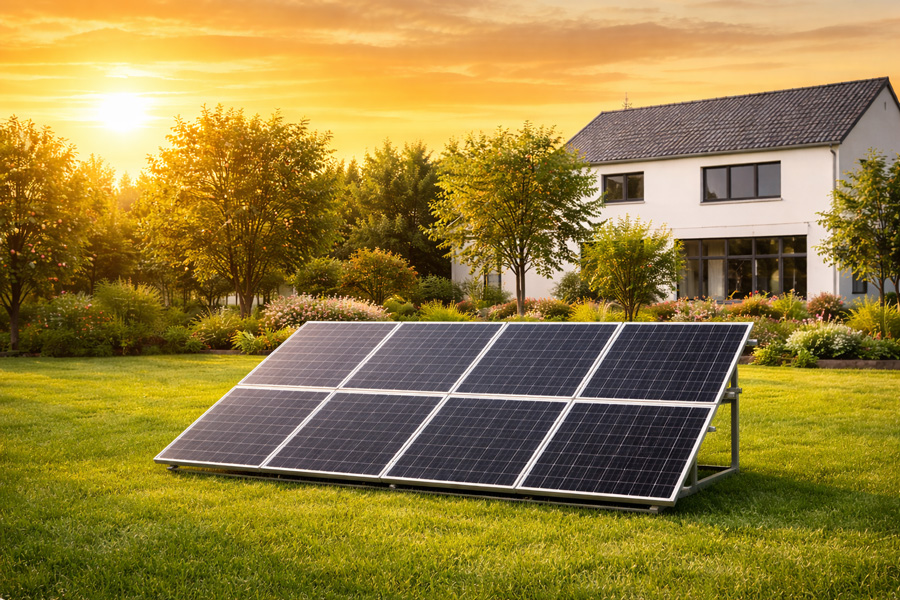
Many outdoor areas are structurally available, but remain unused in terms of energy. This is precisely where wasted potential lies. Pergolas, carports, greenhouses and summer gardens with photovoltaics not only create protection and quality of life, but also become a productive source of energy. Today’s modern planners think twice: functionally and economically.
Why photovoltaics on existing structures is becoming increasingly relevant
The traditional roof areas of a house are often already occupied, structurally limited or not optimally usable in terms of design. At the same time, additional structures such as carports with solar roofs, PV pergolas in the garden, greenhouses with photovoltaic elements or covered summer gardens are being built around the house. These areas offer a clear advantage: they are planned or already exist anyway and can be used to generate electricity without the need for additional surface sealing.
This is not a gimmick, but a clean strategy for more space efficiency. Instead of building unproductive canopies, function, design and energy generation can be combined in one system.
Carport with photovoltaics: protective surface and power generation in one
A carport with photovoltaics is the most direct form of dual use. The roof surface protects the vehicle from the weather and at the same time produces solar power for the household, heat pump or wallbox. This makes economic sense, especially in combination with e-mobility, because generation and consumption are close together.
With a usable area of around 15 to 20 square meters, around 3 to 4.5 kWp can often be installed in practice. Depending on the orientation, location and shading, annual yields of around 2,800 to 4,500 kWh are realistic. This means that a carport is not just a roof, but an active part of the energy concept.
PV pergola in the garden: combining design, shade and solar power
A pergola with photovoltaics is much more than just an architectural extra. It creates shade on the patio, increases comfort in the outdoor area and can also supply solar power. This is a clear added value, especially for modern living concepts, because the construction has a high-quality design effect and makes technical sense.
Depending on the size, active module areas of around 2 to 4 kWp can be implemented on a pergola of around 12 to 18 square meters. This can generate annual electricity yields of around 1,800 to 4,000 kWh. The right planning is crucial here. A good solution does not look like retrofitted technology, but like an integrated overall system.
Greenhouse with photovoltaic elements: Protect plants and generate energy
A greenhouse with photovoltaic elements is particularly exciting because it combines kitchen garden, weather protection and energy generation in one system. Unlike traditional roofing systems, the focus here is not just on the use of space, but on the intelligent balance between light incidence, climate control and electricity yield.
Partially transparent or specifically integrated PV elements can help to shade sensitive areas, better regulate the temperature in the greenhouse and generate solar power at the same time. This is particularly relevant for private garden owners, self-sufficient gardeners and discerning builders who combine function and sustainability.
Technical planning is also crucial here: too much shading can slow down plant growth, too little integration wastes energy potential. Correctly implemented, the photovoltaic greenhouse a sustainable solution for garden areas with added value.
Summer garden with photovoltaics as part of a modern energy concept
A summer garden with photovoltaics combines additional living comfort with energy benefits. Covered outdoor areas are not only visually enhanced, but also functionally expanded. Solutions that combine light transmission, weather protection and energy yield are particularly interesting.
For building owners and modernizers, this is particularly relevant when an architecturally convincing integration of photovoltaics into existing or new structures is required rather than a standard solution.
What is important when planning photovoltaics on pergolas and carports
Not every area is automatically economically viable. Load-bearing capacity, statics, shading, alignment, drainage and electrical integration must be planned in a technically sound manner. Getting this wrong will result in unnecessary costs and compromises in operation.
This is precisely why it is worth looking at specialized providers who not only supply solar modules, but also think about the entire construction as a system.
Conclusion: dual use turns outdoor spaces into real energy spaces
Photovoltaics on pergolas, carports and summer gardens is a logical step for anyone who wants to use space more efficiently. Instead of just building a roof, the result is an additional energy benefit with a direct economic effect.
On sunelements.de shows how such solutions can be implemented in a high-quality, functional and architecturally convincing way. The direction is clear: anyone building or modernizing today should not only design outdoor areas, but actively integrate them into the energy concept.


