
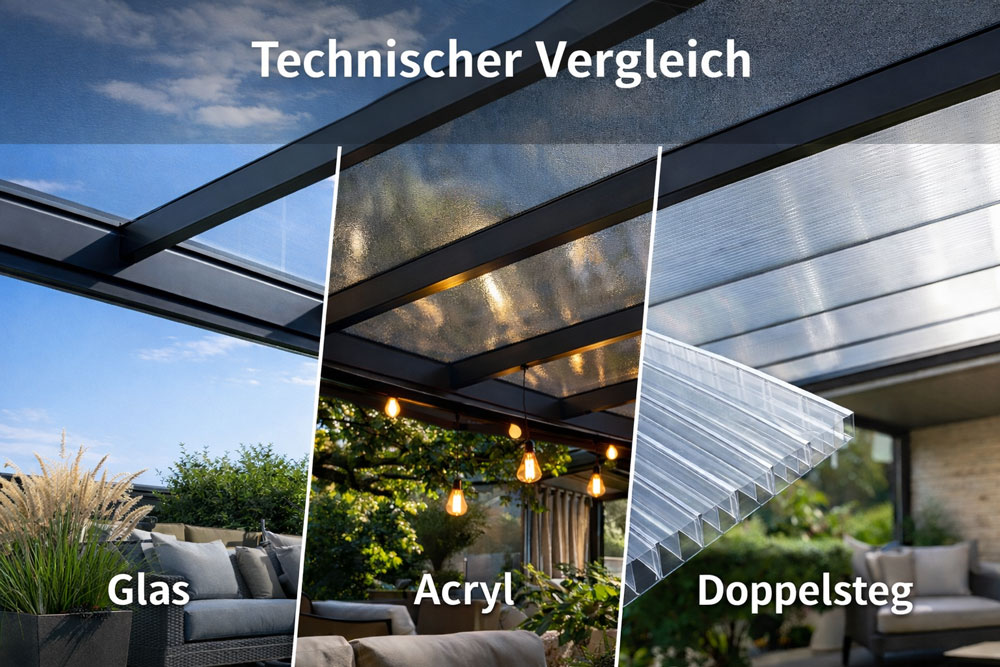
Glass, acrylic or double bridge: which material suits your requirements?
The right question is not “What is better?”, but rather: What requirements does the material have to meet in everyday life? Durability, UV resistance, appearance and care – and all in line with your project: patio roofing, pergola, summer garden or greenhouse. If you make decisions based on gut feeling, you will pay for it later with scratches, yellowing, unnecessary care or premature replacement.
Requirement 1: Lifespan - what really remains valuable after years?
Glass is the benchmark when it comes to ageing. It does not yellow, remains visually stable and is very scratch-resistant in normal use. For discerning buyers who expect a “premium look for years”, glass is the cleanest choice – especially for side panels, because they are permanently in view.
Acrylic glass is durable and provides a very bright, pleasant feeling of light. At the same time, acrylic is generally more susceptible to micro-scratches than glass. This is not a drama – but it is a management decision: Anyone buying acrylic must handle care and cleaning professionally (see below).
Twin-wall sheets are the robust workhorses. They make sense in terms of design if you prioritize functional goals: protection, diffused light, privacy and often a strong price-performance ratio. Visually, they usually have a more technical appearance – which is not a disadvantage if this is exactly what suits the use case.
Requirement 2: UV resistance - who protects materials, people and furnishings?
UV is the silent cost factor. It attacks plastics, bleaches surfaces and changes the appearance and material properties. Therefore, the following applies: not “plastic yes/no”, but “UV protection how implemented?”
Glass is the least critical here because it does not yellow and the appearance remains stable in the long term.
Acrylic glass can be very UV-stable – especially if it has high-quality UV protection and is (optionally) tinted. Tinted acrylic is often the sweet spot: less glare, less heat stress, but still plenty of daylight.
Double-skin sheets also work well in terms of UV technology if the UV protection side is installed correctly and the quality is right. Cheap goods take their revenge: clouding, brittleness, optical waste.
Requirement 3: Optics & light - showroom look or functional comfort?
Expectations are the deciding factor here.
For the showroom look (design, clear lines, maximum transparency): Glass is the strongest answer. It looks architecturally “clean”, high-quality and remains visually stable.
For bright, modern outdoor surfaces: Acrylic provides a very pleasant light image and can be clear or tinted, depending on the version. Many systems in the premium segment rely on acrylic versions for the roof precisely because light control is a real convenience lever here.
For privacy, diffused light and pragmatic function: Twin-wall sheets diffuse light and reduce direct views. This makes them interesting as wall/side elements if you want protection and screening without completely darkening the room.
Requirement 4: Care - what is most efficient in the company?
Time is money. Care must be scalable.
Glass: uncomplicated. Dirt is visible, but with sloping/drainage and standard cleaning, glass remains operationally efficient.
Acrylic: needs a clear maintenance protocol. No aggressive cleaners, no abrasive sponges. If you ignore this, you will produce micro-scratches – and lose out visually.
Double bar: visually tolerant, but a clean system finish is mandatory. Poorly finished edges/finishes are the classic cause of long-term trouble (appearance, deposits).
Material recommendations according to project logic
1) Greenhouse / plant focus (climate, protection, diffused light):
Twin-wall sheets as walls are strategically strong: insulation, diffused light, robust function.
2) Summer garden (living, view, premium look):
glass plays to its strengths on the sides. On the roof, acrylic (clear or tinted) is often a smart comfort driver when light and heat need to be actively managed.
3) Pergola / patio roof (modular, extendable):
System logic is what counts here: extensions, shading, side elements. This is precisely where it is worth taking a look at modular solutions in the SunElements portfolio, because you can often combine the choice of materials for each zone (roof is different from walls).
Conclusion: Decision in one sentence
Glass for an uncompromising premium look, acrylic for smart light and UV management, double bar for robust function and privacy – especially as a wall solution. Everything else is window dressing – and usually ends in retrofitting costs.


