
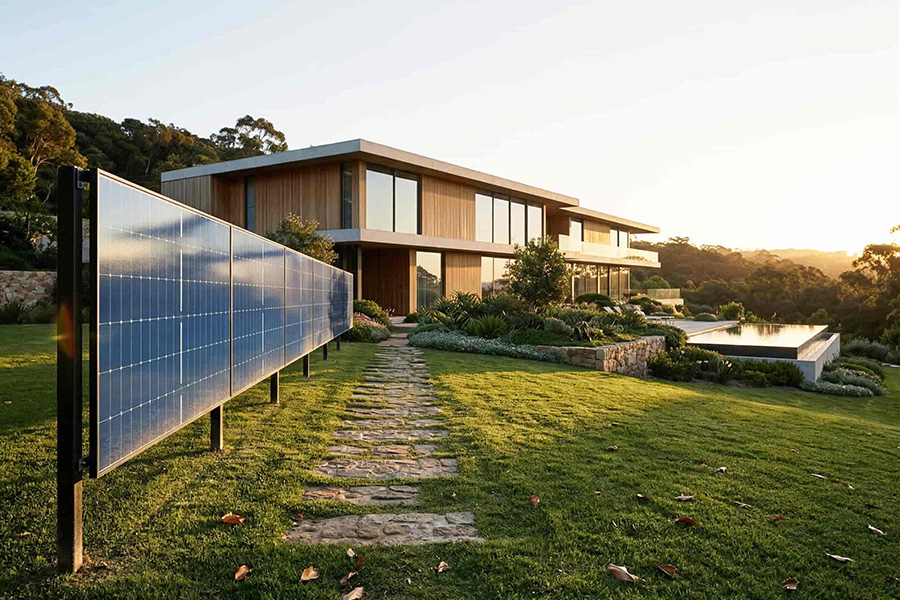
Anyone planning outdoor spaces today no longer wants a “dead” infrastructure. A fence should not just be a boundary – it should provide added value: privacy, design, durability. This is exactly where the modular PV fence comes in: It combines privacy and solar power in one system – without additional roof space and without compromising on the demand for a high-quality home.
SunElements is positioning the PV fence as a robust, low-maintenance solution with bifacial glass/glass modules and the advantage that up to 20 % more yield is possible thanks to the bifaciality.
1) Why a PV fence makes strategic sense now
Classic PV is usually installed on the roof. This makes sense – but is not always optimal. Because:
- Not every roof is ideally aligned or free from shading.
- Many households already have a PV system and are looking for additional expansion areas.
- Outdoor areas are becoming more sophisticated – and with them the demand for every component to “work”.
A PV fence uses an area that is needed anyway. This is dual use without land consumption – and that is precisely why the concept is so strong.
2) Technology reality: Why bifacial glass/glass modules are a quality feature
PV fencing is not a toy. A fence is directly exposed to wind and weather – much more directly than a system on the roof. That’s why module technology is crucial.
Bifacial: flow from the front and rear
Bifacial modules can also generate yield on the rear side – for example through reflected light from ground surfaces. SunElements advertises the PV fence with precisely this bifaciality and cites up to 20 % additional yield as an advantage.
Glass/glass: robustness & durability
Glass/glass construction is established in the premium segment because it is stable and can withstand mechanical loads better than many simple constructions. This is particularly important for fencing, because:
- wind loads and vibrations actually occur,
- hail hits the fence head-on in case of doubt,
- the system is permanently in the “weather edge”.
3) The most important point: statics & wind load - non-negotiable
A PV fence is a free-standing element. This means that wind is its biggest opponent. Wind load acts on the fence like on a sail surface and generates bending moments and torsional forces.
If a system is planned to be modular, the design must be a clean solution: uprights, anchoring in the ground, fastening system and aluminum frame – everything must fit together.
Clear recommendation: If you want long-lasting and low-maintenance, don’t base your decision on “watts per module”, but on the overall system: supporting structure + fastening + module technology + connection concept.
4) Added value in everyday life: privacy, design, energy - all at the same time
The PV fence delivers three results that count in everyday life:
Privacy screen with clear architecture
A fence is a design element. With PV, it becomes a design statement with function: clean, modern, technical.
Energy production without new roof space
This is the business case: you get additional PV area without having to retrofit the roof or make any visual compromises.
Low maintenance instead of high maintenance
SunElements describes the PV fence as robust and low-maintenance.
In practice, this means less vulnerable surfaces, a more stable design and fewer readjustments.
5) For whom is the modular PV fence the right solution?
The PV fence is particularly suitable when:
- you need privacy protection anyway and want to turn it into an energy system,
- you already have PV and want to expand,
- your roof is not ideal (shading/geometry/optics),
- you are planning premium exterior architecture and every element should deliver benefits.
Frequently asked questions about PV fencing
Yes, modularity is a key advantage. The prerequisite is that statics/foundations and the electrical concept (e.g. strings/inverters) are planned to be expandable.
With a high-quality design, the effort required is low: visual inspection and cleaning if necessary. Low maintenance depends primarily on the material, fastening, cable routes and corrosion protection.
The yield depends on the fence length, module output, orientation, shade and location. As a guide: more meters and less shade result in a higher annual yield. For a reliable statement, the project should be calculated with a site plan, fence length and shade analysis.
Wind load is important for PV fencing because the wind presses on the module surface. The forces are transferred via the aluminum frame into the uprights and further into the ground. The uprights are designed to safely absorb the load and keep the fence stable, preventing warping or loosening. Depending on the situation, they can be set in concrete or dowelled; a central upright can also be used for reinforcement.
Often yes, depending on the inverter (free inputs/reserve), the string design (voltage/current), the module type and the overall concept (e.g. storage/self-consumption). A proper connection concept should be planned in advance.
Conclusion: The PV fence is the logical further development of modern outdoor areas
A modular PV fence is not a gimmick, but the logical answer to modern requirements: Privacy + design + energy gain in one system. SunElements meets the spirit of the times here: bifacial glass/glass modules, robust concept, low maintenance – and a clear focus on double space utilization.


